Project coordination · Global lighting deskEN

Guided project services

NVC Lighting Support by Decision Stage

A structured route from application criteria to documents that procurement and installers can use.

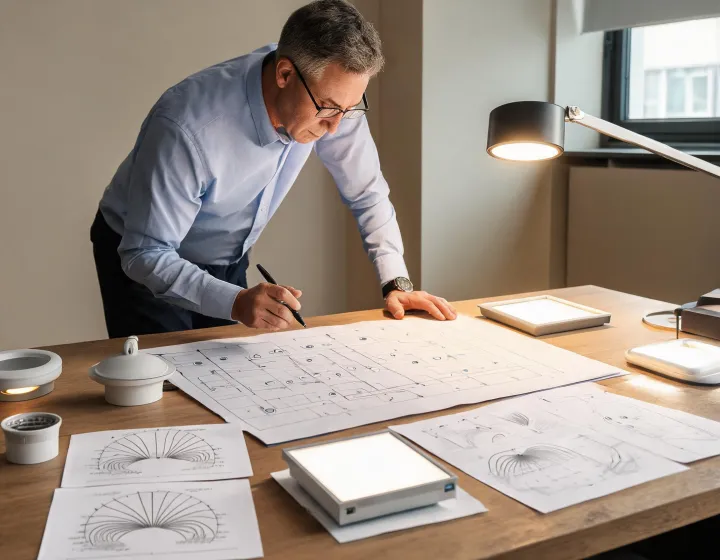
Lighting specialist reviewing plans and samples

Questions grouped before products are proposed

Application review

Room use, visual task, ceiling system, mounting height and maintenance access define the first boundary. A downlight schedule for hospitality circulation cannot be evaluated by the same criteria as classroom panels or retail track heads. We organize these conditions before comparing nominal wattage or catalog families.

Performance coordination

Luminous flux, candela distribution, beam angle, CCT, CRI and UGR are reviewed together. Higher lm/W can lower connected load, while optical shielding and color quality may better support occupant comfort. Current IES or LDT data and project geometry remain necessary for a defensible calculation.

Controls alignment

DALI-2, 0–10V, occupancy sensing and daylight harvesting identify system functions, not guaranteed interoperability. The controls engineer should record zones, minimum dimming, off behavior, emergency overrides and commissioning ownership before release.

Submittal routing

Model-specific drawings, photometric files and applicable UL, CE or RoHS documents are collected for the selected market version. Generic family material is clearly separated from approval evidence.

Common coordination points

Does maximum efficacy determine the best choice?

No. Efficacy influences energy use, but distribution, glare, CRI, vertical illumination and control behavior can justify a different balance. Comparisons should use consistent room assumptions and maintained light criteria.

Does an IP rating cover every environment?

No. IP addresses defined ingress tests. It does not by itself establish chemical resistance, impact rating, corrosion performance, ambient-temperature suitability or every mounting orientation.

When should samples be reviewed?

Samples are useful after the electrical and optical configuration is narrowed. Bench checks can confirm appearance, fit and control response under stated conditions, but they cannot reproduce every field temperature or lifetime cycle.

From incomplete schedule to reviewable package

Before review

“LED panel, 40 W” leaves ceiling fit, luminous flux, glare, color quality, emergency integration, driver access and controls unresolved.

After review

The record identifies dimensions, mounting, optical target, CCT, CRI, control interface, applicable documentation and remaining project assumptions.

Submit one open lighting decision.

Include drawings, schedule and milestone so the response stays relevant to the project.